TS Namdhari Journal
TS Namdhari Guide to the Muktsari Kurta Pajama
Understand the fuller, expressive Muktsari kurta pajama silhouette, how it differs from a standard set, and how to style it with restraint.
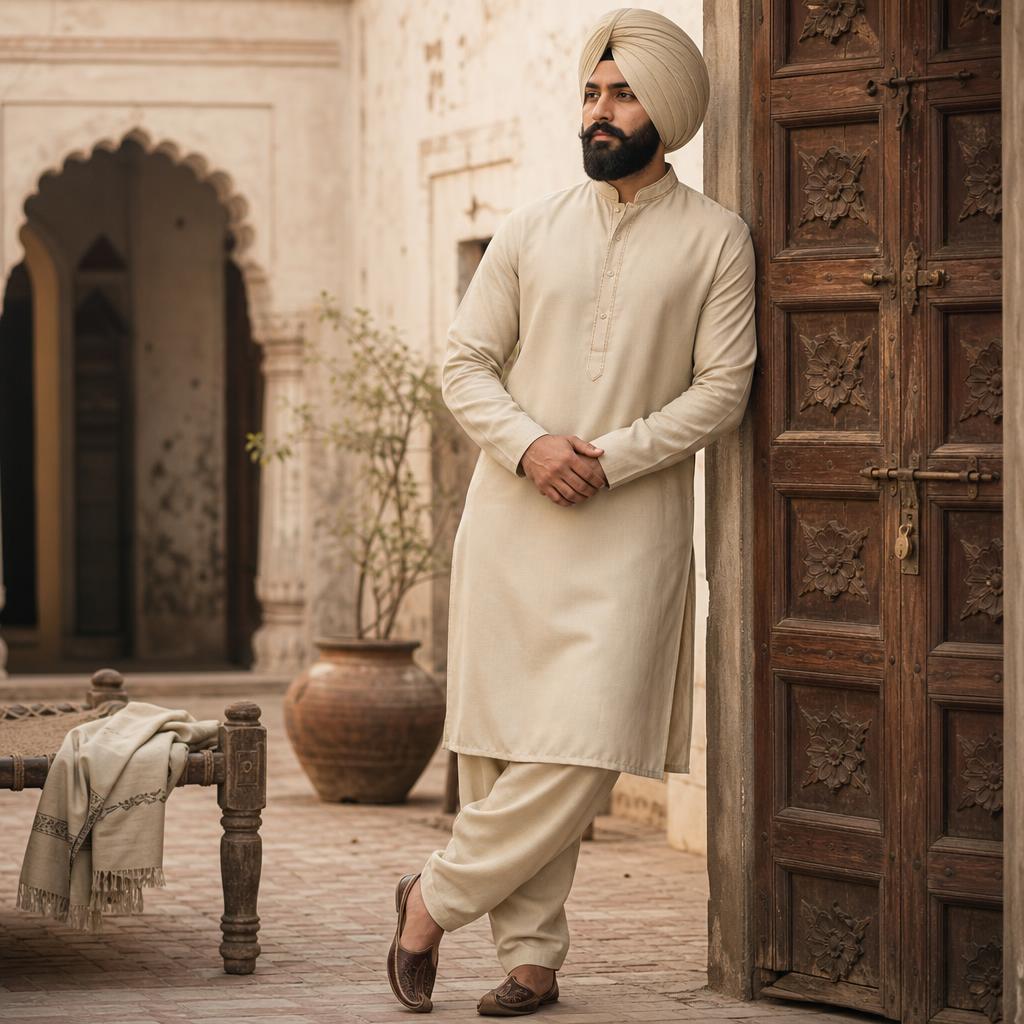
The Muktsari kurta pajama is recognised for a more emphatic Punjabi silhouette: a kurta with presence and a fuller lower shape that moves with it. Usage and exact cuts can differ among tailors and families, so it is wiser to describe it as a regional style vocabulary than a single immutable uniform. TS Namdhari approaches the Muktsari look through proportion—volume, length, drape and movement—rather than reducing it to a costume formula.
What distinguishes a Muktsari Kurta Pajama?
The identifying impression is generosity rather than compression. Compared with a narrow straight-pajama set, the Muktsari interpretation is often associated with a more relaxed, fuller pajama and a kurta whose proportions acknowledge that width. The beauty is in how the pieces answer one another. The kurta should not look accidentally oversized, and the pajama should not become an unshaped mass. Fabric, wearer height and footwear determine how much fullness is appropriate.
Regional identity without overstatement
Punjabi dress has always varied by locality, community, occasion and period. It is inaccurate to treat one contemporary Muktsari cut as the sole historical dress of all Punjab, or to assign meanings that a family has not claimed. What remains valuable is the living recognition of a silhouette: a way of dressing that many wearers associate with regional pride, ease and celebratory Punjabi style. A good tailor listens to that personal reference and avoids turning it into caricature.
Cutting the silhouette with control
Volume needs distribution. Extra width may be placed so the garment moves well through the seat and leg while avoiding strain at the waist. The rise must allow sitting comfortably; a very low or restrictive rise defeats the point of an easy lower garment. Kurta length should be considered against the pajama’s fullness, with side slits supplying movement without breaking the line too sharply. Lighter cloth creates a softer sweep; more structured fabric makes the volume more graphic.
This is why a fitting matters. Walk several steps, sit, and look at the garment from front, side and back. The look should retain definition in motion. For the component-level choices behind that result, visit our anatomy of a Punjabi kurta pajama.
Everyday, wedding and contemporary styling
For everyday or daytime gatherings, choose breathable cotton or linen-like texture in off-white, soft blue, stone, muted green or another tone that feels natural in daylight. Keep the neckline and buttons quiet; clean juttis or restrained leather footwear will ground the volume. For a wedding function, richer fabric, a deeper colour or subtle woven texture can add occasion without relying on heavy ornament. A waistcoat should be tested with the kurta, not added as an afterthought, because it changes the torso-to-leg balance.
Contemporary styling works when it edits rather than erases the silhouette. A cleaner cuff, refined placket, or more controlled hem can bring clarity. Avoid narrowing the pajama until its character disappears, then calling the result Muktsari. Conversely, do not add every visual signal at once. One considered fabric, good fit and appropriate footwear usually speak more clearly.
Colour and accessories
Let the colour family lead. An ivory kurta with a cream lower garment creates a quiet tonal field; a deeper kurta can be paired with a lighter pajama when the contrast is deliberate. If a pagri is part of the occasion, its scale and colour become part of the composition. Read our guide to coordinated pagri and kurta pajama dressing before choosing it by colour alone. Accessories should add a point of finish, not visual noise.
Choosing fabric for movement, not merely appearance
Because the silhouette carries volume, the cloth deserves special attention. A very stiff material may make the lower garment stand away from the body in a way the wearer does not intend; an extremely fluid cloth may need careful cutting so the shape does not lose definition. Medium-weight cotton is often a practical starting point for daytime use. Textured fabrics can give a festive set depth, but a tailor should assess their opacity, weight and recovery before deciding on width and finish.
Season matters as well. A garment for a warm afternoon needs ventilation and an easy hand, while an evening event may permit a richer surface. Do not assume that more cloth automatically means more heat: weave and fibre matter, but so does whether the garment has been given unnecessary layers or dense embellishment. The most successful Muktsari set feels generous to move in, not burdensome to wear.
Making the reference your own
Bring a family photograph or a garment reference if it helps explain the feeling you want, but use it as a starting point. A copied measurement may not suit your posture; a colour that worked under one event’s lighting may not suit another. The tailor can preserve the qualities you admire—ease, length, lower-garment shape or a particular neckline—while adjusting them to the present wearer. That is more respectful than treating regional dress as a frozen image.
Consider maintenance in the same conversation. A white or pale set may be ideal for repeated daytime wear if its cloth can be cared for confidently; a special texture may be better reserved for a planned function. The goal is a garment that earns repeat wear, not one left waiting for a perfect occasion.
Fit notes for a fuller silhouette
Do not judge the set standing entirely still. The kurta should fall back into place after a step, and the pajama should offer ease at the knee and seat without collecting awkwardly at the ankle. A beltless or drawstring waist needs particular attention: it must remain comfortable through a meal without allowing the lower garment to slip. Small adjustments in rise, hem and width can transform both confidence and comfort.
For a first Muktsari set, restraint is often the wiser route. Start with manageable volume in a cloth that drapes predictably, then refine future versions once you know what feels right. This leaves room for individual expression while retaining the style’s generous spirit.
Where the style belongs today
The Muktsari expression can be meaningful at a family celebration, a cultural gathering or an occasion where the wearer wants a recognisably Punjabi line. It need not be reserved for spectacle. What changes with the setting is the degree of richness: quiet cotton and clean finishing for day; deeper colour, a refined weave or a considered layer for evening. The style remains convincing when the wearer chooses it with familiarity and comfort, rather than borrowing signals without context.
Frequently asked questions
What is a Muktsari Kurta Pajama?
It refers to a Punjabi regional style expression commonly recognised for a more generous kurta-pajama proportion, especially a fuller lower silhouette. Exact cuts vary.
Is Muktsari style only for weddings?
No. In practical cotton and a restrained cut it can suit daytime gatherings and personal traditional dressing; richer cloth makes it more festive.
Should a Muktsari pajama be very loose?
It should have purposeful ease, not uncontrolled bulk. The right amount depends on height, fabric and how the kurta is cut.
Can a shorter man wear a fuller pajama?
Yes, with careful control of kurta length, rise and hem. A tailor can keep the silhouette clear rather than letting volume dominate.
What footwear works best with a Muktsari kurta set?
Well-made traditional footwear or understated formal footwear usually works. Test it with the finished hem length, not in isolation.
Conclusion
The Muktsari kurta pajama succeeds because it understands ease as an aesthetic, not a lack of discipline. It carries regional flavour without needing exaggerated signals. TS Namdhari can help translate a client’s reference, occasion and comfort needs into a silhouette that moves confidently; arrange a consultation to begin with the right proportion.